Showing posts with label news. Show all posts

Sunday, 4 September 2011

Google Voice for Android updated with tablet support

The Google Voice app just received another update this evening, bumping it to version 4.2.34 and bringing a very short (but welcome) change log -- tablet support.  We've seen just how easy it is to sideload the app onto your tablet, and plenty of folks noticed the way the action bar looks more tablet-like in the update a few days ago, but now it's more official with it sitting right in the Market, waiting for you to download it.
So get to it -- link is after the break.


Wednesday, 31 August 2011

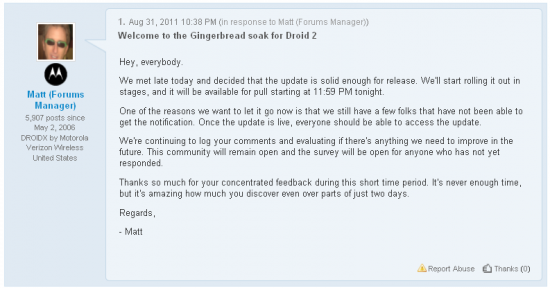
Motorola Droid 2 Gingerbread OTA Update Rolling Out Tonight


That’s right, folks. Tonight’s your lucky night if you’re a Droid 2 user. Seems the Gingerbread soak test for the Motorola Droid 2 went over well seeing how Moto is to begin rolling out the tasty Android treat for the masses starting tonight at 11:59PM. This will bring your device up to Android 2.3.3 and all the Gingerbread goodies that come along with it. Are you guys as hyped about this as I am (and I don’t even own the device)? As always make sure your phone is fully charged and don’t forget to leave a comment once the update is pushed to your device! Good luck and godspeed.


Source: phandroid

Wednesday, 11 May 2011

Google Streamlines Android Market


SAN FRANCISCO — Android’s explosive growth over the past three years has been a double-edged sword for its apps. On the plus side, there are more of them than ever. On the negative side, there are more of them than ever.

Google on Wednesday announced a slew of updates aimed at improving customers’ ability to find and buy apps in the Android Market, as well as developers’ ability to sell them.

“The biggest problem we have in the Market is discovery,” said Michael Novak, Android engineer for Groupme.com, in an interview. “Google has definitely heard the complaints from people like me, and these new features being rolled out are proof.”

Navigability issues have plagued Google’s app-shopping system on the customer end, making it hard for people to find the apps they want, or even to realize that there are apps they might be interested in. For their part, developers have complained that it’s easier to make money in Apple’s App Store than it is in the Android Market.

For customers, finding the most popular apps may get easier with one of the many new lists Google has added, each detailing the top performing apps in specific categories. The Twitter-esque top “Trending” list, for example, highlights the most-downloaded apps over the past seven days. If an app continues to be among the highest-downloaded over that seven-day period, it will move into either the “Top Paid” or “Top Free” lists, which cover popularity over a 30-day period.

Google’s addition of the “also viewed” and “also installed” lists add an interesting social component to the market. It’s almost taste-making through app downloads — if you like a particular application you’ve installed, you can browse a number of applications also installed by others who installed your particularly enjoyable app.

And while these new list additions make it easier for customers to search for new apps to download, it’s also better for app developers who want their apps to be showcased more prominently on the Market. More lists across more categories means more opportunities for a developer’s app to be seen by customers. And that means more opportunities to get paid.

Some think progressions like these are long overdue.

“These are features that Apple has had for years,” said industry analyst Michael Gartenberg. “These sorts of features are table stakes at this point in the game.”

Indeed, Google’s Android Market web store, a version of the store that’s accessible through your computer’s browser, first debuted in February. In contrast, iPhone users have been able to access the App Store by web browser since February 2010.

As Google tackles these problems, the market’s patronage continues to expand. Although historically the Android Market’s customer base has been focused on the United States and a handful of other countries, Google’s “Android developer ecosystem manager” Eric Chu says it’s important to pay attention to the burgeoning international market. Over 60 percent of the 400,000-plus daily Android device activations are now coming from outside the United States, according to Chu.

Google wants take advantage of this growing international market. Next week, says Chu, Android developers will be able to accept payment from 131 different countries across multiple currencies.

In direct contrast to Apple, however, Google’s app store has typically been lauded by open source enthusiasts for its lack of vetting process in accepting apps from developers. Submitting an app to Apple’s App Store requires direct approval from the company before the app can be sold to the public. Google’s process is more open.

This week has brought a host of different additions and expansions for the Android Market. On Tuesday, Google announced a movie-rental service addition to the market, which allows you to wirelessly stream films to your Android smartphone or tablet devices for a period of up to 24 hours after first renting the film. The current selection ranges in the thousands, with prices starting at $2 for older films and $4 for more-recent releases.

Google TV will receive access to the Android Market for the first time this summer, which may help the ailing television platform garner a larger following. Developers will also receive a Honeycomb 3.1–based software developer kit to begin building Google TV–specific apps at some point in the coming months.

Source: wired

Thursday, 28 April 2011

Shocker! Free Android apps outnumber free iPhone apps


Good news for Android users who hate paying for stuff: according to new numbers from Netherlands-based mobile analytics group Distimo, there are now more free apps available for Google's mobile OS than the iPhone, at 134,342 to 121,845. There are a few things to consider here: first, when one adds free iPad-only apps, the total number of gratis iOS apps increases to a more competitive 132,239. And then there's Apple's sometimes rigorous vetting process, which has probably played a role in its numeric slippage -- after all, this report doesn't highlight things like legality, repetition, or the overall number of apps dedicated to making farting noises. Also, Apple has a lot more premium apps, giving it the overall lead at 333,124 to 206,143 -- but between Android's rapid growth and what the report terms iOS's relative stagnation, Distimo expects Google to take the top spot in five months' time, outnumbering iPhone and iPad apps combined -- a rough scenario for Cupertino to stomach, no doubt, but at least the company will still have Windows Phone to kick around a while longer

Source: Distimo

Tuesday, 8 March 2011

Android Developers Blog: The Android 3.0 Fragments API

An important goal for Android 3.0 is to make it easier for developers to write applications that can scale across a variety of screen sizes, beyond the facilities already available in the platform:
  • Since the beginning, Android’s UI framework has been designed around the use of layout managers, allowing UIs to be described in a way that will adjust to the space available. A common example is a ListView whose height changes depending on the size of the screen, which varies a bit between QVGA, HVGA, and WVGA aspect ratios.
  • Android 1.6 introduced a new concept of screen densities, making it easy for apps to scale between different screen resolutions when the screen is about the same physical size. Developers immediately started using this facility when higher-resolution screens were introduced, first on Droid and then on other phones.
  • Android 1.6 also made screen sizes accessible to developers, classifying them into buckets: “small” for QVGA aspect ratios, “normal” for HVGA and WVGA aspect ratios, and “large” for larger screens. Developers can use the resource system to select between different layouts based on the screen size.
The combination of layout managers and resource selection based on screen size goes a long way towards helping developers build scalable UIs for the variety of Android devices we want to enable. As a result, many existing handset applications Just Work under Honeycomb on full-size tablets, without special compatibility modes, with no changes required. However, as we move up into tablet-oriented UIs with 10-inch screens, many applications also benefit from a more radical UI adjustment than resources can easily provide by themselves.

Introducing the Fragment

Android 3.0 further helps applications adjust their interfaces with a new class called Fragment. A Fragment is a self-contained component with its own UI and lifecycle; it can be-reused in different parts of an application’s user interface depending on the desired UI flow for a particular device or screen.
In some ways you can think of a Fragment as a mini-Activity, though it can’t run independently but must be hosted within an actual Activity. In fact the introduction of the Fragment API gave us the opportunity to address many of the pain points we have seen developers hit with Activities, so in Android 3.0 the utility of Fragment extends far beyond just adjusting for different screens:
  • Embedded Activities via ActivityGroup were a nice idea, but have always been difficult to deal with since Activity is designed to be an independent self-contained component instead of closely interacting with other activities. The Fragment API is a much better solution for this, and should be considered as a replacement for embedded activities.
  • Retaining data across Activity instances could be accomplished through Activity.onRetainNonConfigurationInstance(), but this is fairly klunky and non-obvious. Fragment replaces that mechanism by allowing you to retain an entire Fragment instance just by setting a flag.
  • A specialization of Fragment called DialogFragment makes it easy to show a Dialog that is managed as part of the Activity lifecycle. This replaces Activity’s “managed dialog” APIs.
  • Another specialization of Fragment called ListFragment makes it easy to show a list of data. This is similar to the existing ListActivity (with a few more features), but should reduce the common question about how to show a list with some other data.
  • The information about all fragments currently attached to an activity is saved for you by the framework in the activity’s saved instance state and restored for you when it restarts. This can greatly reduce the amount of state save and restore code you need to write yourself.
  • The framework has built-in support for managing a back-stack of Fragment objects, making it easy to provide intra-activity Back button behavior that integrates the existing activity back stack. This state is also saved and restored for you automatically.

Tuesday, 25 January 2011

British engineers planning to send an Android phone into space

A team of engineers at SSTL and the Surrey Space Centre in Guildford want to see if the sophisticated capabilities in today’s mobile phones can function in the most challenging environment of all: space.
Why are they doing this you might be asking? Shaun Kenyon, the project manager at SSTL, said, “They come now with processors that can go up to 1GHz, and they have loads of flash memory. First of all, we want to see if the phone works up there, and if it does, we want to see if the phone can control a satellite.”
Although the specific phone model to be used hasn’t been announced yet, SSTL wants to use the phone to control a 30cm-long satellite and take pictures of the Earth in the mission later this year. If this works, it could potentially save tons of money and weight for future similar projects in space.
The team chose Android because of its open source software, which means they can tweak it if need be.
“We’re not taking it apart; we’re not gutting it; we’re not taking out the printed circuit boards and re-soldering them into our satellite – we’re flying it as is,” Kenyon explained. ”And, in fact, we’re going to have another camera on the satellite so we can take a picture of the phone because we want to operate the screen and have some good images of that as well.”
All I know is I can’t wait to see pictures of this Android smartphone in space! What device do you think they’ll choose? Let us know in the comments.

Source: BBC

Wednesday, 19 January 2011

The Good News About Android's Version Distribution

When you develop a product and use liberal licensing terms, there's always the risk that someone else will use your code to create a poor product. Maybe it will include a lot of unnecessary features, it will be slow and have a lot of bugs or it will never use the latest version of your software.

Android's goal was to be a common baseline that enables innovation in the mobile space. Convincing other companies to use Android wasn't easy and that's one of the biggest Google accomplishments. Not many people believed in Android's success three years ago and its adoption rate is still surprising.

Convincing companies to update their Android-based firmware faster is much easier. If users only buy Android phones that have the latest version of the operating system and constantly request phone manufacturers and carriers to update the software, then they'll work harder to improve their products.

Google has recently released some information about the current distribution of the Android versions and the good news is that 87.4% of the Android phones use Android 2.x, up from about 55% in July. 51.8% of the phones use Froyo, a version released 7 months ago. In only one month (August 2010), Froyo's share grew from 5.5% to more than 28%, after Motorola and HTC updated phones like Droid, Droid Incredible, Evo 4G, and Desire.


ZDNet says that "almost 13% of Android users are still running versions of the mobile OS that are several generations old and these users will never see Android 2.1", but this percentage is constantly decreasing. Even if they're using Android 1.6, that's still a much better operating system than the one from a feature phone and it still lets them use many apps from the Android Market. A slower update rate is a small price to pay for creating an ecosystem of heterogeneous devices that run the same operating system which is not perfect, but it's "good enough".

Source: googlesystem

Wednesday, 29 December 2010

iPhone 4 and Nexus S: Which smartphone is right for you ?

Android
Six months after moving to Apple's smartphone, I'm back on Android. On December 17, I bought the Samsung-made Google Nexus S from my local Best Buy. Days later, my iPhone 4 sold on eBay for $575, which will cover my early termination fee with AT&T and some of the new phone's cost. Like any other tech purchase, I did research beforehand but couldn't find what I most wanted: iPhone comparison to Nexus S reviews -- Apple's flagship smartphone to Google's superphone. After nearly two weeks using Nexus S, I'm ready to offer some experiential comparisons for other shoppers.

Click here to find out more!To be clear, I wasn't dissatisfied with iPhone 4. On the contrary, I was hugely satisfied with the phone and the user experience. Apple's smartphone feels solid to hold, offers breathtaking display and shoots pleasing photos and videos. With the exception of ongoing Bluetooth earpiece problems, iPhone satisfied -- perhaps too much. Psychologists say that marriages often break up not in a flurry of anger or arguments but silence. Two people drift apart, one day realizing they have little left in common. That sentiment in some ways describes my feelings about iPhone 4. Three-and-a-half years after the original phone launched, the iOS user interface is pretty much the same. The UI feels stale, uninviting and too PC-like. I love the hardware, but no longer pine for the software.

An iPhone 4 Divorce
My software breakup started months earlier, when my 89 year-old father-in-law switched to iPhone 4. In process of watching him struggle to use the device, I suddenly saw in a new way the inconsistencies of the user interface, such as the button in the left hand corner  of some standard phone functions leading "back" but doing something different, too (text messaging is good example). There was a consistency about his confusion -- when encountering UI inconsistencies and oddities.
Other things bugged me. For example, photo sharing is cumbersome on iOS compared to Android. The iOS presents a few standard sharing options, like e-mail and MMS, but the services are all Apple's. By comparison, Android exposes APIs to third-party developers. When using the Nexus One, the newer Google phone's predecessor, I could upload photos directly to Facebook, Twitter or Tumblr immediately, without having to truck over to their apps (unlike iPhone). This example represents the difference in openness of the two mobile platforms.
In June, I switched to iPhone 4 from Nexus One, which my wife still uses. I generally liked the Android phone but there were accuracy problems with the touchscreen and the AMOLED screen washed out in sunlight, making the phone essentially unusable. When I had the Nexus One, it ran Android 2.1 (now 2.2). I like versions 2.2 and 2.3 less; there are more steps required for some really basic functions, like making phone calls. The point: Android's user interface is becoming unnecessarily complex in some respects. However, in many others, such as adjusting settings or getting notifications, even Android 2.3 is superior in its simplicity compared to iOS.
Nexus S


Google Nexus S side view showing curvy screen
Some reasons why Nexus S appealed to me compared to iPhone 4:
1. It's the new Google phone. Nexus S is Google branded, with no carrier crapware installed. The smartphone is based on the popular Samsung Galaxy S series, and it will be first to get the newest Android operating system version updates.
2. Nexus S runs Gingerbread. Android 2.3 is tasty. What can I say? I like sweets.
3. The Super AMOLED screen overcomes Nexus One's sunlight blindness -- and it's crisp and clear enough compared to iPhone 4.
4. I like the Samsung Galaxy S series -- too bad the Nexus S misses some features. I'd be happier if like T-Mobile's Samsung Vibrant variant, Nexus S had 720p video and microSD slot to augment the 16GB internal storage. That said, the Nexus S is gorgeous and loaded with goodies.
5. I was bored with iOS and longing for Android. As aforementioned, I was ready for the iPhone 4 divorce. I just wanted the right phone to switch to-- something like the Nexus One in concept but not the shortcomings.
How Do the Phones Compare?
There is no apple (or is that Apple?) to apple comparison. Each smartphone appeals in its own way. I mostly prefer the Nexus S to iPhone 4, but I could just as comfortably use Apple's smartphone. These are both exceptional quality phones. For many people, one or the other will be a matter of taste, assuming they're not contractually committed to the wireless network supporting the other phone.
Quick Specs: iPhone 4
  • Processor: Apple A4.
  • Storage: 16GB or 32GB; available to applications.
  • Dimensions: 115.2mm high by 58.6mm wide by 9.3mm deep, weighing 137 grams.
  • Display: 3.5 inches, with 960-by-640 resolution; 326 dots per inch; 800:1 contrast ratio.
  • Wireless: UMTS/HSDPA/HSUPA -- 850, 900, 1900, 2100 MHz; GSM/EDGE -- 850, 900, 1800, 1900 MHz; 802.11b/g/n WiFi; Bluetooth 2.1 + EDR; Assisted GPS
  • Cameras: VGA front-facing and 5-megapixel back-facing (backlit CMOS and high-dynamic range capabilities); VGA video from front and 720p from the back, both 30 frames per second; LED flash on back camera.
  • Claimed battery life: 7 hours talk, 5 hours Internet
  • Carrier locked: Yes, in most geographies
  • US price: $199 for 16GB and $299 32GB with two-year contractual commitment to AT&T. No commitment: $599 and $699, respectively.
iPhone 4


iPhone 4
Quick Specs: Nexus S
  • Processor: 1GHz Samsung Cortex A8 (Hummingbird).
  • Storage: 16GB; 1GB available to applications.
  • Dimensions: 123.9mm high by 63mm wide by 10.88mm deep, weighing 129 grams.
  • Display: 4 inches, with 800-by-480 resolution; 235 dots per inch; 100000:1 contrast ratio.
  • Wireless: HSDPA/HSUPA -- 900, 1700, 2100 MHz; GSM/EDGE -- 850, 900, 1800, 1900 MHz); 802.11b/g/n WiFi; Bluetooth 2.1 + EDR; Assisted GPS; Near Field Communication.
  • Cameras: VGA front-facing and 5-megapixel back-facing; VGA video from front and 720 x 480 from the back, 30 frames per second; LED flash on back camera.
  • Claimed battery life: 6.7 hours.
  • Carrier locked: No
  • US price: $199 or $249 with two-year contractual commitment to T-Mobile. No commitment: $529.
In the United States, iPhone 4 is locked to AT&T's network; even when unlocked by the user, high-speed data is not available on the other major GSM network, T-Mobile. The Nexus S is unlocked and uses T-Mobile's data frequencies. The phone is good for voice on AT&T but only EDGE for data. Note to T-Mobile subscribers: The Nexus S tops out at 7.2Mbps; it does not support T-Mobile's so-called 4G network speeds.
First-Hand User Experience
The Nexus S' most distinctive feature is the curved screen, which feels noticeably more comfortable against the face than iPhone 4 or other smartphones I have used. The screen is bright, with rich contrast that is superior to iPhone 4. The capacitive touchscreen is scarily responsive, like it's reading my mind and producing letters before I touch the screen. That's not too far from the truth. In testing, I find the screen responds without touch, if I hold my fingers just above the letters.
Nexus SBut it is the speed I first noticed. The Nexus S is fast, noticeably more than iPhone 4, which is saying a lot, since Apple's smartphone is no slouch. From a usability perspective, I much prefer Android's simply inspired notifications compared to Apple's seemingly hacked on approach. If, for example, Facebook isn't on the main iPhone screen, the user might not realize he or she has notifications, which appear as a numeral against the application icon. On Android, a unified notifications bar appears at the top of screen and pulls down to reveal them.
Android also places phone function or application settings on the same screen (after you untuck them), rather than how iPhone forces the user to go to a separate, consolidated "settings" application. Another nicety: Widgets running on the desktop. I use the featured "Google News/Weather" widget throughout the day. I'll add others to one of the home screens, as I find time.
Nexus S' battery life, while good, simply doesn't compete with iPhone 4, which is an exceptional performer. I would guess Nexus S delivers about 80-85 percent the time of iPhone 4. Strangely, I find talk time to be longer on Nexus S compared to iPhone 4, while Apple's phone lasts longer for data usage.
As a journalist, the camera is a high priority for me. Unquestionably, iPhone has the edge, particularly for video. But I find the Nexus S delivers satisfying performance -- certainly good enough -- and there are some actual controls for adjusting settings while taking pictures, such as white balance and exposure compensation.
Like other Android handsets, Nexus S syncs to the cloud -- no PC required, unlike iPhone 4. Apple offers some cloud sync capabilities, but users must still backup the device to a computer and receive updates there. Android updates OTA -- over the air. I presume that Nexus S, like the N1, will restore all apps and settings OTA if the phone is reset.
There remains the question of mobile apps. Apple claims 300,000 in the App Store, but what about Google? According to AndroLib, the Android Marketplace now has more than 200,000 applications. I won't quibble the number, which isn't Google official, but will say this: I had absolutely no problem finding all the applications I needed.
Which phone is right for you? I can't say. Hopefully this post will help your decision-making process. But nothing beats actually handling a phone, which I suggest you do on several trips. It's an important commitment (if bound by carrier contract that you'll live with for years) that deserves some hands-on experience. The Nexus S is right for me, and I have no regrets.

Source: betanews

Android trojan horse Geinimi spotted stealing user data in the wild

Another trojan horse for devices running Google’s Android mobile operating system — this one capable of stealing information and uploading it to remote servers — has been spotted on third-party Android application marketplaces.

The Geinimi trojan horse gets onto your device via games and other applications that users download off third-party application marketplaces outside of the official Android Marketplace. Applications that are corrupted by Geinimi ask Android users to verify a much larger set of permissions than the application is supposed to verify, and then send that information off to remote servers.

While Geinimi hasn’t made a malicious move yet, mobile cyber security firm Lookout suspects it is building a botnet — an army of devices that can be controlled remotely — like trojan horses and other types of malware do with typical computers.

Malware on mobile devices is still a new trend. But it’s a little disconcerting to see another sophisticated trojan horse come out on Google’s Android operating system just a few months after one made a splash on Russian Android phones by forcing phones to send premium text messages.

Lookout is warning Android users to stick to well-known and well-rated applications on the Android Marketplace. The Android operating system is particularly vulnerable to attack, since just about anyone can upload apps bearing malware to the Android Market. Those apps often trick users into giving them permission to do something to the user’s phone.

Cyber criminals are targeting smartphones because they aren’t as well protected as computers with anti-malware software, said Bradley Anstis, vice president of technology for M86 Security, a security technology company in Orange, Calif. Other mobile devices are also becoming increasingly ubiquitous — mobile tablet computers are expected to be a big hit and bring in $24.9 billion in revenue next year.

Google’s Android mobile operating system isn’t the only one at risk, either. The Zeus virus was released on Nokia phones running the Symbian operating system recently. It was able to compromise online-banking apps that use text messages to verify mobile transactions.
 Source: venturebeat

Thursday, 2 December 2010

Introducing the Android Phone Power Rankings

Today we're introducing a new feature to AndroidGuys called the Android Phone Power Rankings.  The idea behind it is simple.  We all have our own opinions as to how great we think various Android handsets are, but what do we think as a collective unit? I conducted a blind rating poll for each phone offered by the carriers in the United States.  This includes current models, but also retired and unique phones like the Nexus One and G1.  In future polls, we'll be including phones from around the world.Keeping certain things in mind, each device was given a "Power" number between one and ten.  What factored into the rating?
  • Handset Age
  • Carrier
  • Hardware
  • Current version of Android
  • Expected future platform support
We were curious to see how things would stack up.  Would it be newest phones at the top?  Would a certain carrier own the high spots? Would one handset maker score more favorably than others?  Well, without further ado, here's the first Android Phone Power Rankings - The top 25 handsets as picked by your AndroidGuys staff.  Where does your phone stack up?
  1. Samsung Epic 4G (Sprint)
  2. HTC EVO 4G (Sprint)
  3. HTC Nexus One (T-Mobile)
  4. Samsung Vibrant (T-Mobile)
  5. Motorola Droid X (Verizon)
  6. Motorola Droid 2 (Verizon)
  7. HTC Droid Incredible (Verizon)
  8. Motorola Droid (Verizon)
  9. Samsung Captivate (AT&T)
  10. HTC myTouch 3G Slide (T-Mobile)
  11. HTC myTouch 3G (T-Mobile)
  12. Motorola i1 (Sprint)
  13. Samsung Intercept (Sprint)
  14. Sony Ericsson Xperia X10 (AT&T)
  15. HTC Aria (AT&T)
  16. HTC G1 (T-Mobile)
  17. HTC Hero (Sprint)
  18. Samsung Acclaim (U.S. Cellular)
  19. LG Ally (Verizon)
  20. Samsung Moment (Sprint)
  21. Motorola Charm (T-Mobile)
  22. Motorola CLIQ XT (T-Mobile)
  23. Motorola Devour (Verizon)
  24. Motorola CLIQ (T-Mobile)
  25. Motorola Backflip (AT&T)

Android 2.x Now On 83% Of All Phones

Slowly but surely, most Android users are moving on to something vaguely resembling a modern version of the OS, with a full 83% of users running Android 2.1 or better. That number is pretty evenly split between 2.1 and 2.2, and older versions considerably behind. There’s also a pretty neat graph at the link showing how these numbers have changed over the last six months, and the Android 1.x numbers are on a pretty steady decline.
Now, lets see how Gingerbread and Honeycomb shatter this graph into little pieces, only to slowly recombine over the course of six-months, as updates slowly roll out for more handsets.

Android device:  Search Amazon.com for android device

Tuesday, 30 November 2010

ViewSonic G Android tablet rocks Tegra 2, 10-inch screen, $400 price

 Where should you go for a high-end tablet? No, you shouldn’t go to TJ Maxx, you should head over to Office Depot to pick up the ViewSonic G tablet because this Android-powered device looks pretty powerful.

How powerful? Well, the ViewSonic G Android tablet is powered by the Tegra 2 processor, which has performed quite admirably on Android benchmarks. This should just be the first tablet to utilize Tegra 2, as we’re expecting a slew of devices to emerge next year.

Like the Apple iPad, the ViewSonic G tablet will feature a 10-inch screen. You can look for 1080p HD video playback and 1024 x 600 resolution.

You can also look forward to a front-facing camera for video calls, Bluetooth and WiFi (including 802.11n), a microSD slot and USB connectivity. There should also be 16 GB of onboard storage and 512 Mb of RAM.

The ViewSonic G tablet will be powered by Android 2.2, or Froyo. While Google has said this isn’t optimized for tablets, we’ve found it to be very solid on devices like the Samsung Galaxy Tab.

Some of you may be hesitant to buy a computing device from ViewSonic, which is mostly known for high-quality monitors. We’ve had a chance to check out the company’s other tablets and we came away impressed with the build quality and overall polish of the device.

One of the best things about the ViewSonic G tablet is that is should cost $399 from Office Depot and the online stores. That’s about $100 cheaper than the Apple iPad (unless you’re able to snag it from TJ Maxx) and it should also be cheaper than the WiFi-only version of the Galaxy Tab, which should hit Best Buy early next year.

As tempting as this device is, I’d still advise most people to wait a few months before diving into this market. After CES in January, we should know more about the competitive landscape.
Source: intomobile


Sunday, 28 November 2010

Amazon offering amazing deal on Droid devices

This month, Amazon is offering amazing prices on Verizon’s Droid line, which includes the Droid Incredible for a jaw-dropping price of 1 cent! Other prices include the Droid X which can be yours for a very reasonable price of $99, the Droid 2 (the regular edition, not the Global) which goes for $80, and the Droid Pro which sells at $150.

If you’re interested in any of these deals, you would need to order between 12 midnight PDT on November 19, 2010 and 11:59 p.m. PDT November 29, 2010, which also gives you a lot of time to choose which one would be best suited for your needs and your budget. Also, all of these deals require a 2-year contract, so if you are looking around for one of the best deals on the market for a new Droid and a new contract, you can check out Amazon for their really great deals.

Monday, 22 November 2010

awsome number - 600,000 Galaxy Tabs sold worldwide in first month

Samsung told the Korea Herald newspaper over the weekend that it has sold more than 600,000 units of its Galaxy Tab 7-inch Android tablet in the first month of its launch. Available in more than 30 nations in North America, Europe and Asia, the Galaxy Tab essentially is an  upscaled Android device, running Froyo on a 1GHz processor, Some 30,000 units were sold in Korea since Nov. 14, the newspaper wrote. By comparison, Apple announced it had sold somewhere in the neighborhood of 1 million iPads in its first month. 
Source: koreaherald

On November 26th - NTT Docomo will begin selling the Samsung Galaxy Tab

While the numbers are still rolling in regarding just how many units Samsung has moved of the Galaxy Tab, that hasn't stopped the flurry of carriers popping up to state they to will be making the device available for customers. NTT Docomo is the latest know addition. As announced on their press release website, NTT Docomo will begin selling the Samsung Galaxy Tab nationwide throughout Japan as of November 26. No pricing details were announced at this time.

The advantages of the Optimus One on MetroPCS

Sometimes the best move in a rivalry is to bide your time. That’s what MetroPCS did to counter its rival, Cricket. During the summer Cricket launched the Kyocera Zio, a low-end Android handset. It recently added the Huawei Ascend. Both of these devices came before MetroPCS added an Android handset. That changed today, as MetroPCS go the Optimus M. I’d say that it’s a big victory for both MetroPCS and prepaid-seeking smartphone users.

Instead of going with a cheap, lesser known Android handset, MetroPCS went right for a hugely popular model. Over a million Optimus One units have already sold, so they’re taking in a proven winner. That should make the handset more attractive to subscribers. The Zio looks a bit cheap, and few consumers recognize the name Huawei. But they do recognize LG, and a quick Google search will show how well the Optimus has sold. I expect this to sell better on MetroPCS than the other two combined on Cricket.

The downside is that the Optimus M costs $230, which is considerably more than its Cricket Android counterparts. Again, the name recognition should help MetroPCS overcome this price point. Consumers are willing to pay for quality.

What, then, of its competition with postpaid carriers? As we saw, both T-Mobile and Sprint are offering the Optimus for rather cheap — $50 or even free. That’s the price consumers will have to pay for an unsubsidized handset. Even still, it’s just $30 more than the upper tier Android handsets on contract, so it’s not that big of a leap. MetroPCS also offers unlimited everything at $60 per month, which beats the bigger carriers. Even with my Everything 500 plan on T-Mobile I’m paying over $90 per month with taxes and fees. With MetroPCs you just plop three twenties down on the counter and your bill is paid.

In this case, waiting appears to be the best strategy. It helps MetroPCS against its biggest rival, because now MetroPCS has the clearly superior Android handset. It helps in competition against contract carriers, because the per-month rate is quite a bit cheaper. Even then, the two-year cost of ownership is much cheaper on MetroPCS. The Optimus T is free on T-Mobile, but again the bill comes to around $90 per month. If you buy the Optimus M for $230, you make up the difference in about eight months. MetroPCS should market the hell out of that fact.